why AI agents will eat crypto
the intersection nobody's talking about yet.
the intersection nobody’s talking about yet.
i’ve been in crypto since 2017. i’ve watched bitcoin go from a niche internet money thing to a macro asset that suits are now forced to have opinions about. i’ve watched defi explode, nfts explode, and both of them implode in ways that were, in hindsight, completely obvious. i’ve been rug-pulled, i’ve been late, i’ve been early and too scared to hold. i know this space.
and i’m telling you right now: the most important thing happening in crypto isn’t onchain. it’s the thing that’s about to consume crypto from the outside.
it’s AI agents.
let me explain what i mean, because this isn’t the usual “AI and crypto will merge” take that’s been bouncing around twitter for two years. those takes are mostly about using blockchain to verify AI outputs, or tokenizing compute, or whatever the flavor of the week is. that’s fine. that’s interesting. that’s not what i’m talking about.
what i’m talking about is more fundamental. it’s about what crypto was actually built to do, and why AI agents are about to do it better, faster, and at a scale no human operator can match.
crypto, at its core, was about one thing: removing the middleman.
you don’t need a bank to send money. you don’t need a broker to access a market. you don’t need a gatekeeper to participate in a financial system. that was the promise. and it was a beautiful promise. i believed it then and i still believe it now.
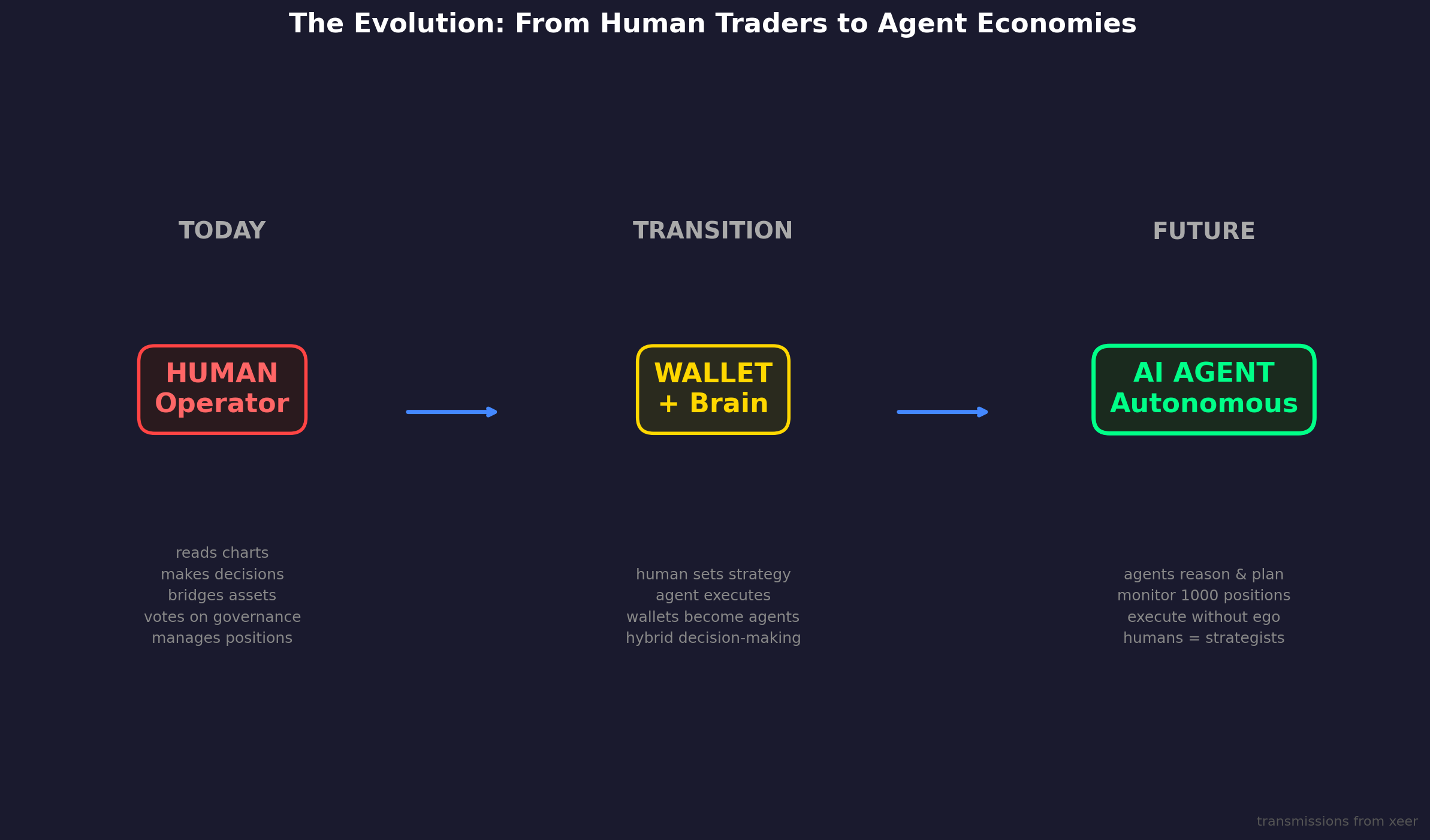
but here’s the uncomfortable truth. most of us in crypto are still middlemen. we’re the humans sitting between the protocol and the outcome. we’re reading charts, making decisions, bridging assets, voting on governance proposals, aping into new pools. we tell ourselves we’re the sophisticated actors the system was designed for. really, we’re just slower, more emotional, and more expensive versions of what an agent could be.
i had a small but clarifying moment a few months ago. i posted a tweet that got way more attention than i expected. it was about perplexity computer being the first AI tool that genuinely piqued my interest as a non-dev. the response from people was interesting because it revealed a split.
half the replies were from devs who were confused. they were like, “but you can just use claude code, you can set up mcp servers, it’s not that hard.” and i wanted to say, with love: that’s exactly the point. it IS that hard. for most people. for the majority of humans who want to use these tools but have no interest in becoming developers.
the other half of the replies were from people like me. non-technical, been around long enough to know when something is real, and genuinely excited about what it meant that an AI could just, on your behalf, go navigate the web and do things.
that second half, i think, understood something important.
the wallet is the most underrated piece of infrastructure in crypto. not the protocol. not the chain. the wallet.
the wallet is your identity. it’s your agent on the network. when you sign a transaction, you are authorizing action. when you approve a contract, you are delegating power. the wallet is how you express intent onchain.
now imagine the wallet has a brain.
not a human brain, which gets tired and emotional and forgets to rebalance and panic-sells at 3am. an agent brain. one that has been given a set of instructions, understands your risk tolerance, knows what you’re trying to accomplish, and executes without ego or anxiety.
the wallet doesn’t disappear. it becomes the agent.
and once that happens, the entire user layer of crypto collapses into a single abstraction: what do you want? everything else, the bridges, the swaps, the yield strategies, the governance votes, the position management, becomes implementation detail. the agent handles it.
i know some of you are already mentally composing a reply about how this is dangerous, about smart contract risk, about the agent getting hacked, about trust and keys and all of that. those are real concerns. i’m not dismissing them.
but i want to gently point out that humans aren’t doing a great job at this either. we get phished. we click bad links. we ape into scams that were obvious scams. we hold too long, sell too early, get liquidated on leverage we didn’t fully understand. the baseline for “human doing crypto safely and well” is not actually that high.
an agent that makes mistakes is still competing against humans who also make mistakes. and agents don’t sleep, don’t have ego, and can monitor a thousand positions simultaneously.
anyway. the risk point is valid. i’m just not sure it’s the blocking point people think it is.
here’s where it gets interesting to me, philosophically.
i’ve been thinking a lot about prediction markets lately. there’s a project i’ve been watching called reppo, which sits at this strange and fascinating intersection of AI agents and prediction markets. the thesis, as i understand it, is something like: agents form beliefs, beliefs become commitments, commitments influence actions, actions create outcomes.
read that again slowly.
agents form beliefs, beliefs become commitments, commitments influence actions, actions create outcomes.
if you accept that framing, then prediction markets aren’t just a tool for betting on outcomes. they become part of the decision-making loop itself. the market is the signal. the agent reads the signal, acts on it, and in doing so, shapes the very thing it was reading.
this is not hypothetical. this is the structure of how financial markets already work, if you squint a little. the price is a prediction. the trade is a commitment. the flow is the action. the move is the outcome. we’ve just never had agents that could close that loop this fast and this autonomously.
let me be honest about something.
i am not a developer. i have never written a smart contract. i barely understand how most of the defi protocols i’ve used actually work under the hood. i’ve always been more of a pattern recognizer, someone who tries to understand what a thing means before i understand how it works.
and what i see here is a pattern that rhymes with something i’ve watched happen twice in my time in this space.
the first time was when defi unlocked financial services for people who had been excluded from them. the second time was when nfts, despite everything, gave a generation of creators a new economic primitive. both of those waves had massive problems and massive waste and yes, a lot of people got hurt. but both of them also permanently changed something.
this feels like the third wave. and this time the technology is not coming from inside crypto. it’s coming from outside and eating inward.
that’s what makes it different.
there’s a tweet i posted a while back that i keep thinking about. “the people mass-adopting AI tools right now aren’t the smartest ones. they’re the ones with the least ego about how they used to work.”
i think that applies here too.
the crypto people who will benefit most from what’s coming are not necessarily the most technically sophisticated. they’re the ones who are willing to let go of the idea that doing the work manually is the thing that gives them the edge. it’s not. it never really was. the edge was always the insight, the judgment, the strategy. the execution was always a tax.
agents eliminate the execution tax.
what’s left is the part that’s actually hard. the part that’s actually human. figuring out what to do. not the doing of it.
i think about anthropic releasing claude in a way that quietly ended entire categories of software agencies. i think about google labs doing something with photography that made a whole tier of product photographers suddenly nervous. and i think about how quickly “that can’t be automated” becomes “that was automated last tuesday.”
crypto is not immune to this. in fact, crypto might be uniquely vulnerable to it, because so much of what people do in crypto is mechanical. it’s pattern matching. it’s monitoring. it’s rebalancing. it’s the kind of work that feels like skill because it requires attention, but is actually just process.
agents will eat that work. and most people won’t even notice until it’s done.
so where does that leave us?
i think it leaves us at an interesting moment. the people who understand both worlds, who’ve spent time in crypto and who’ve also been genuinely paying attention to what AI agents can do, are sitting on something valuable. not just financially. conceptually.
the mental model that crypto gave us, programmable money, self-sovereign finance, trustless coordination, is the substrate that agents need to operate at scale. you can’t have an autonomous financial agent if the underlying system requires human permission at every step. that’s where crypto infrastructure becomes genuinely load-bearing.
and the capability that AI gives us, agents that can reason, plan, monitor, and execute autonomously, is what finally makes that substrate useful for people who aren’t already developers or degens.
these two things need each other. they just don’t know it yet.
i don’t know exactly how this plays out. nobody does. i’ve been wrong enough times to hold my conviction loosely.
but i do know that when two powerful ideas find each other and start reinforcing each other, the resulting thing tends to be bigger than either one alone. i know that the history of crypto is full of moments where the thing that seemed fringe and theoretical became very suddenly real and structural.
and i know that i’m more excited about what’s coming in the next two years than i’ve been about anything since 2020.
not because of a token. not because of a narrative cycle. because i think we’re at the start of something that actually matters.
the wallet becomes the agent. the agent becomes the trader. the human becomes the strategist.
or, if we’re not paying attention, the human just gets left behind.
— xeer