the $3m lesson
i tried to buy every dip. here's what actually happened.

i didn’t lose $3 million in one trade.
i wish i had, honestly. one catastrophic loss is a story with a clear villain. a clear moment where you can point and say: there. that’s where it went wrong. you learn the lesson, you move on, you post a thread about it and people call you brave.
what actually happened is worse. i bled it out slowly, across years, across cycles, one “generational opportunity” at a time.
let me take you back to a specific feeling.
it’s early 2026. eth is hovering around $2,000, down from its all-time high of nearly $4,950 set back in august 2025. i’m sitting at my desk in singapore convincing myself this is the trade. this is the moment. the kind of price you tell your grandchildren about. i bought. not a small amount.
and then, almost immediately, vitalik started selling.
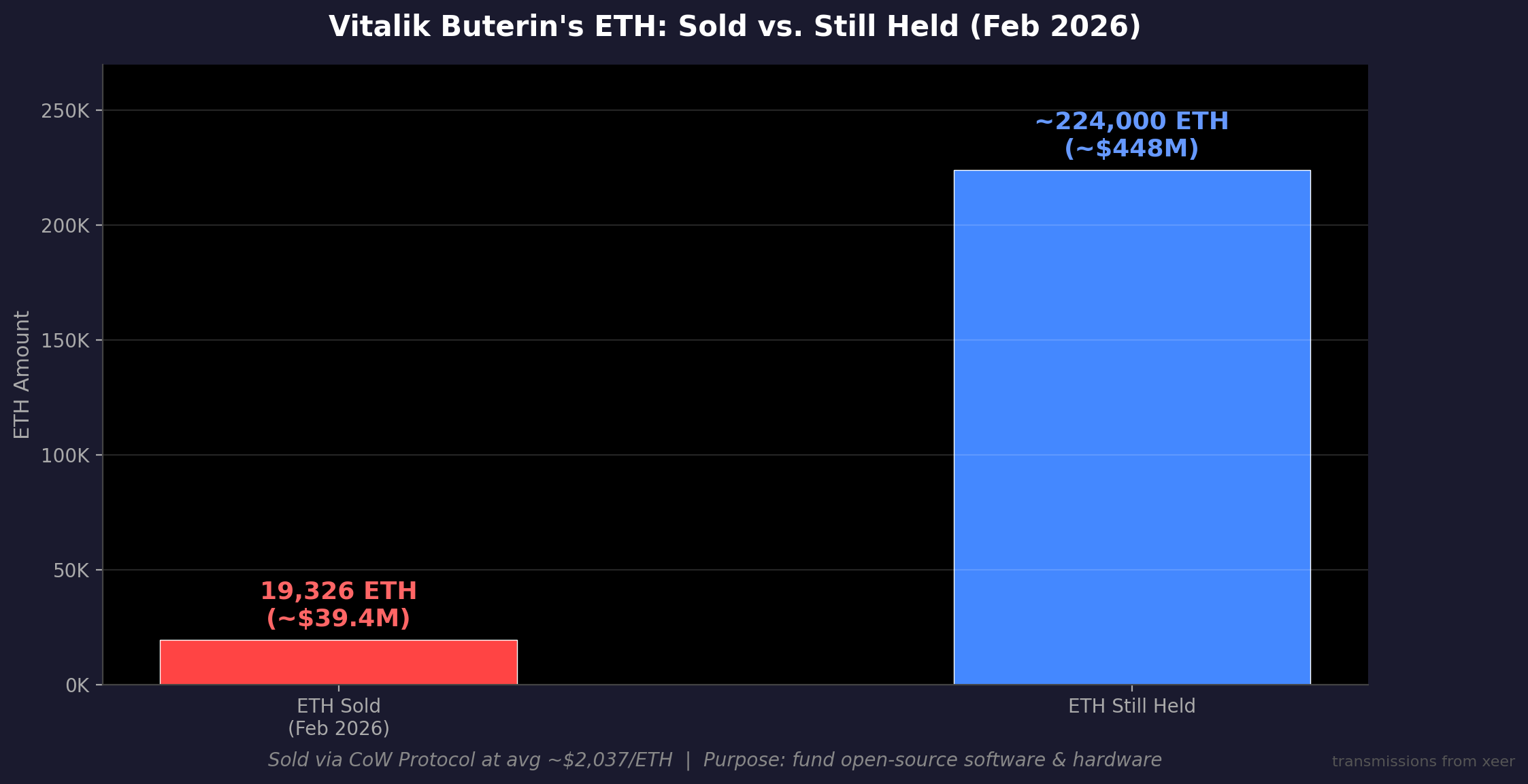
not metaphorically. literally. the man who created the thing i just bought with conviction, at what i thought was an obvious floor, moved roughly 19,000 ETH, around $39 million worth, through CoW Protocol over the course of february. announced it publicly on january 30th. purpose: funding open-source software and hardware development. noble. completely reasonable. and absolutely devastating to watch in real time when you’ve just loaded up.
i remember refreshing the on-chain data. i remember the numbers. i remember thinking, okay. okay. that’s a thing that happened. he still holds about 224,000 ETH, so it’s not like he’s leaving. but the optics of the creator selling tens of millions while you’re buying with conviction, that stays with you.
i held anyway, because that’s what you do when you have conviction.
i averaged down twice more.
here’s the thing about conviction in crypto: it’s almost always real. that’s what makes it so dangerous.
i wasn’t delusional. i wasn’t gambling in the way people outside this space imagine gambling. i had read the whitepapers. i had watched the cycles. i had been in this long enough to have some scars already and i thought those scars were wisdom. i thought they were tuition paid.
they were. the problem is i kept signing up for more classes.
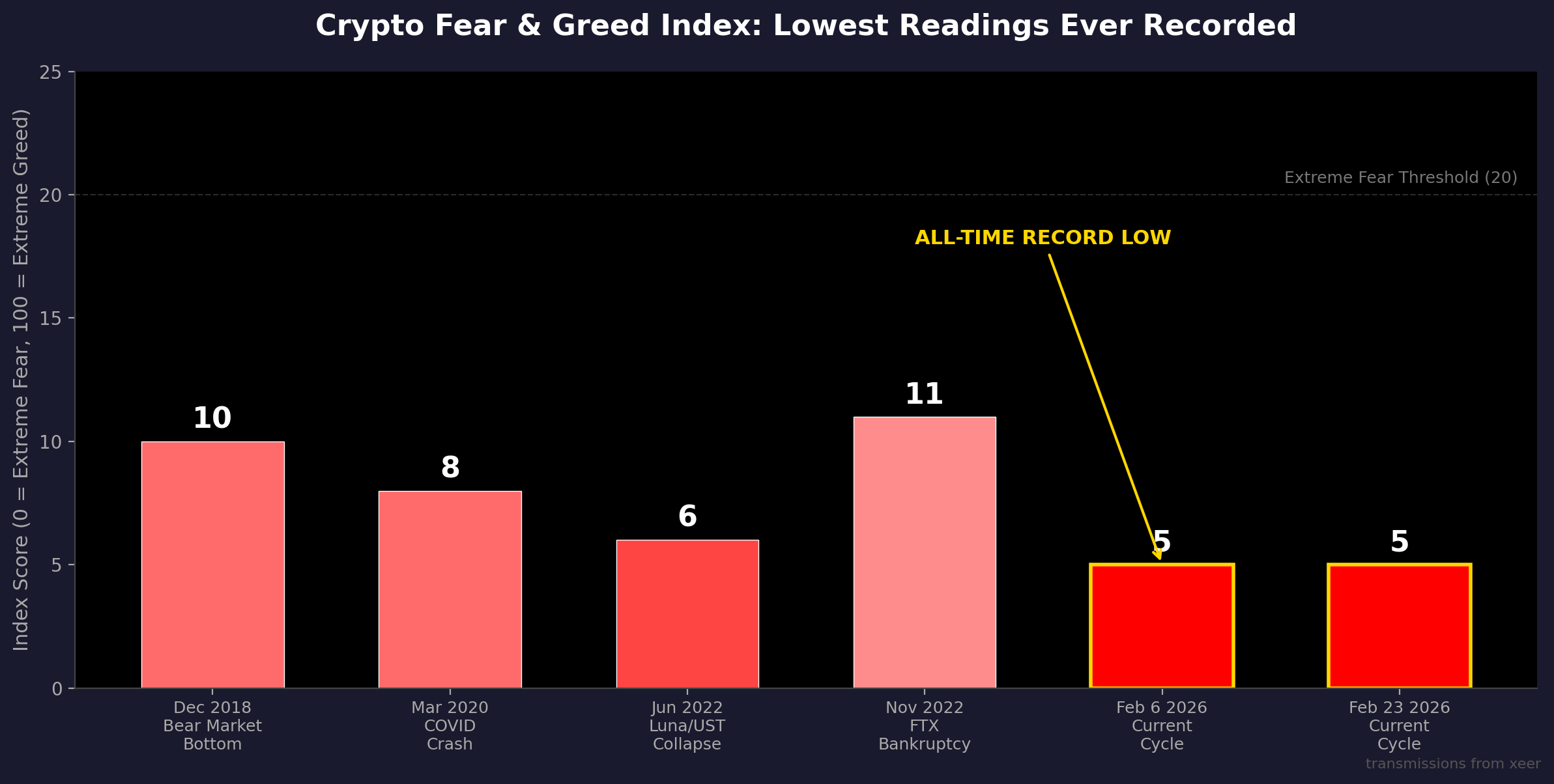
the fear and greed index hit 5 this cycle.
five. the lowest reading ever recorded since the index was created in 2018. not during luna. not during ftx. not during covid. this time. february 6th, 2026, and then again on february 23rd. for context, during the luna collapse in 2022 the index bottomed at 6. during the covid crash in march 2020 it hit 8. during ftx it only got to 11. we went lower than all of them.
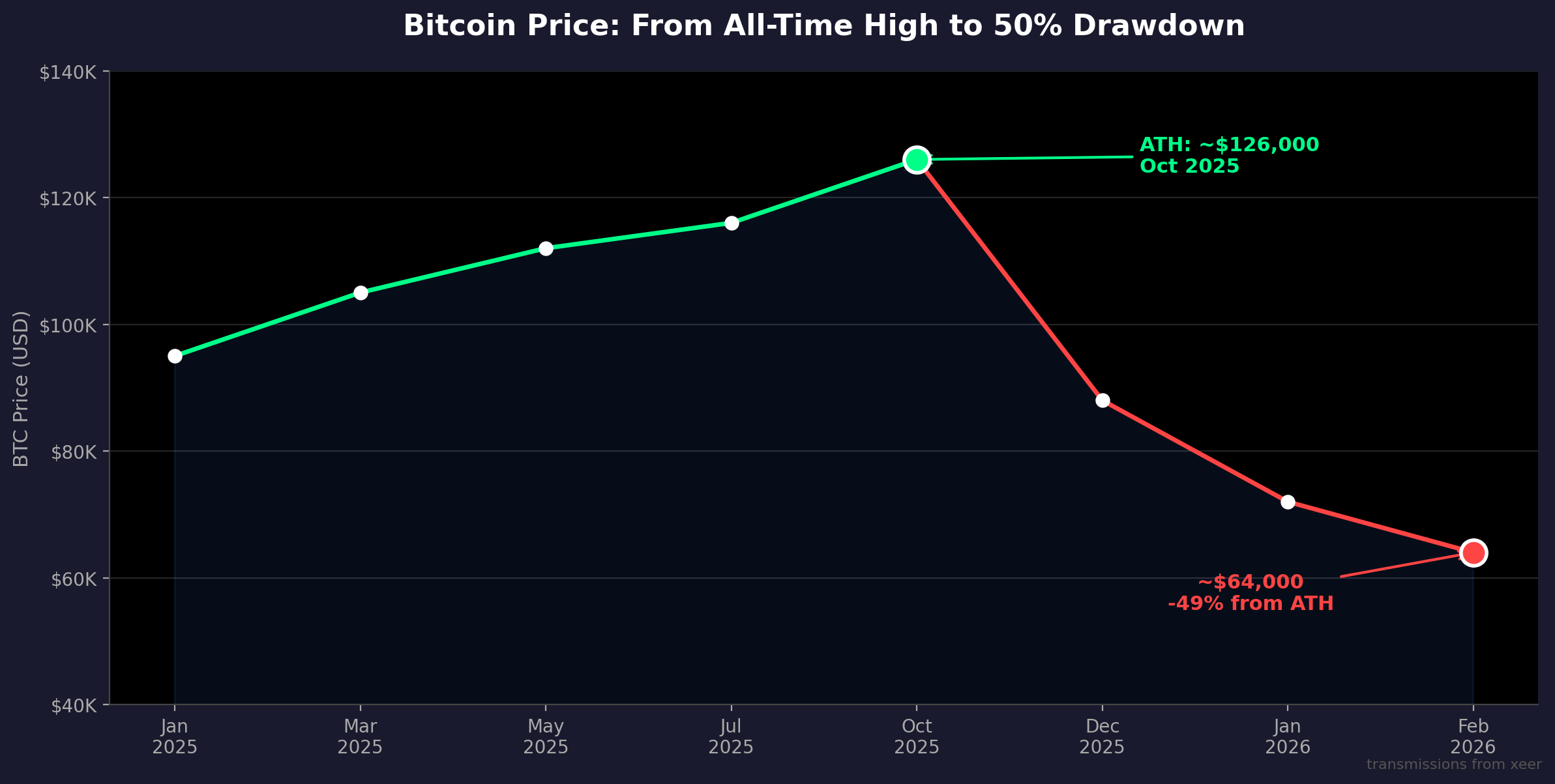
bitcoin had fallen from its all-time high of roughly $126,000, set back in october 2025, to around $60,000. a 50% drawdown. eth had dropped from nearly $5,000 to under $2,000. the entire market shed trillions.
and i remember sitting with that number, 5, and thinking: this is it. this is the bottom. nothing gets more fearful than this.
so i bought.
in other words, i did exactly what you’re supposed to do, technically. be greedy when others are fearful. that’s the buffett quote everyone screenshots. that’s the playbook. i followed the playbook.
the market did not care about the playbook.
i think about this a lot. the playbook is real. the advice is not wrong. being greedy when others are fearful is, in aggregate, the correct posture. but “in aggregate” does a lot of lifting in that sentence. in aggregate means across hundreds of decisions, with correct sizing, with a timeline you can actually survive. it does not mean loading up every time the index prints a scary number and then sitting on your hands watching it go lower, telling yourself you’re being contrarian while your portfolio tells a different story.
there’s a version of that advice that is wisdom and a version that is cope. i was fluent in both.
anyway. let me try to be honest about the number.
$3 million is not a precise figure. it’s the approximate cumulative cost, across multiple cycles, of operating with conviction but without a system. it’s buying bayc at the top because the community felt real, and it did, and then watching it bleed for two years. it’s sizing into eth at what felt like obvious value and averaging down four more times. it’s the ordinals. it’s the altcoin bets that went to zero because the team was actually jane street in disguise, running the most polished market manipulation i’ve ever seen.
it adds up. not in one dramatic moment but in dozens of reasonable-feeling decisions that each had a story attached.
the story is always so good. that’s the part they don’t warn you about.
i’ve posted versions of this publicly. the joke about keeping $10 million in a bank account for a rainy day, the observations about liquidity, the commentary on greed indices. people interpret these as flexes or ironic detachment. some of them are. but a lot of them are me processing, in public, the ongoing cost of being someone who actually believes in this technology and cannot seem to stop acting on that belief in the most expensive possible ways.
the truth is, i believe in crypto the way a person can believe in something and still be terrible at it.
i believe in the infrastructure. i believe in the long arc. i’ve been here since 2017, through enough cycles to know that the people who stayed have generally done okay, eventually, if they had the stomach and the runway. that part i still believe.
what i stopped believing in is the idea that conviction alone is a strategy.
here’s what buying every dip actually costs you, and i don’t mean financially.
it costs you calibration. every time you buy a dip and it keeps dipping, a small part of your internal price-discovery mechanism breaks. you start second-guessing every signal, including the real ones. you become either numb or paranoid, sometimes both at once. you develop this specific cognitive tic where you can construct a bull case for anything because you’ve had to construct bull cases for everything just to survive holding it.
that’s a real problem. the market can stay irrational longer than you can stay solvent, but it can also stay irrational long enough to rewire how you think. i’ve watched sharp people become bad traders not because they got unlucky but because they survived wrong. they learned the wrong lessons from the right outcomes and the right lessons from the wrong ones.
i am probably guilty of this. probably still.
the really insidious version of this is when you’re right about the asset and wrong about the timing for long enough that the two collapse together in your memory. you tell yourself you called the eth run because you were buying at $2,000. you don’t fully account for the fact that you were also buying at $3,500, at $2,800, at $2,200, and that the blended cost made the eventual recovery feel a lot less triumphant than the original conviction deserved.
what actually changed for me, slowly and without a single clear moment, was something close to this:
conviction is not position sizing.
those are two separate things and i was treating them as the same thing for years. i could be right about eth being undervalued at $2,000 and still be wrong about how much to buy, when to buy, how many times to average down, and what i would do if it went to $1,500 and then $1,200. the belief and the execution are different skills. i only practiced one of them.
a system doesn’t mean you stop believing. it means you decide, before you’re in the trade, what the trade looks like when it’s wrong. and you actually follow that plan instead of inventing a new thesis for why this dip is different from the last one.
i didn’t have that. i had stories.
the other thing, and this one is harder to admit: i think i liked it.
not the losses. the action. the feeling of being in the arena, of having skin in the game, of watching the candles and knowing you had a position. there’s something about this space that selects for that personality, and then rewards it just enough, just often enough, to make it very hard to change.
the cycle itself becomes the product. you’re not just investing. you’re participating in a narrative, and the narrative needs you to keep doing the thing.
staying in the game matters, genuinely. i still believe that. but there is a difference between staying in the game and never leaving the table.
i’m still in crypto. i’m not writing this from the other side of some clean exit. i still have positions, i still watch the charts more than a healthy person should, i still feel the pull when something starts moving.
but i’m a little different now. not enlightened. not fixed. just quieter about it, internally. a little more willing to do nothing. a little less convinced that sitting out a move is the same as losing.
the $3 million is gone. some of it came back in other ways, other cycles, other bets that worked. the net number is better than it sounds if i’m being precise. but the lesson isn’t really about the money.
the lesson is that doing something is not the same as doing the right thing, and in a market that rewards action and punishes patience in the short term, that confusion is catastrophically easy to maintain.
i maintained it for a long time.
i’m working on it.
— xeer